


Be Energy : Solutions Batteries Plus
LES BATTERIES PLOMB
Stationary battery maintenance: 9 mistakes that shorten battery life
In telecommunications facilities, data centres, industrial infrastructure and uninterruptible power supply (UPS) systems, batteries can remain on float charge for several years before being called upon during a power outage.
Throughout this period, ageing continues. Temperature, charging parameters, installation conditions and a lack of maintenance can gradually degrade their internal components.
The problem is that this deterioration is not always visible. A battery can display a normal voltage while having lost a significant proportion of its capacity, leaving it unable to provide the required backup time.
Whether dealing with flooded lead-acid, AGM or GEL stationary batteries, good operating and maintenance practices can help limit certain premature ageing mechanisms. Nickel-cadmium (NiCd) batteries also require monitoring tailored to their specific characteristics.
Temperature, float charging, electrolyte levels, ventilation and capacity testing: here are 9 common mistakes that can shorten the service life of stationary batteries, along with the best practices to avoid them.
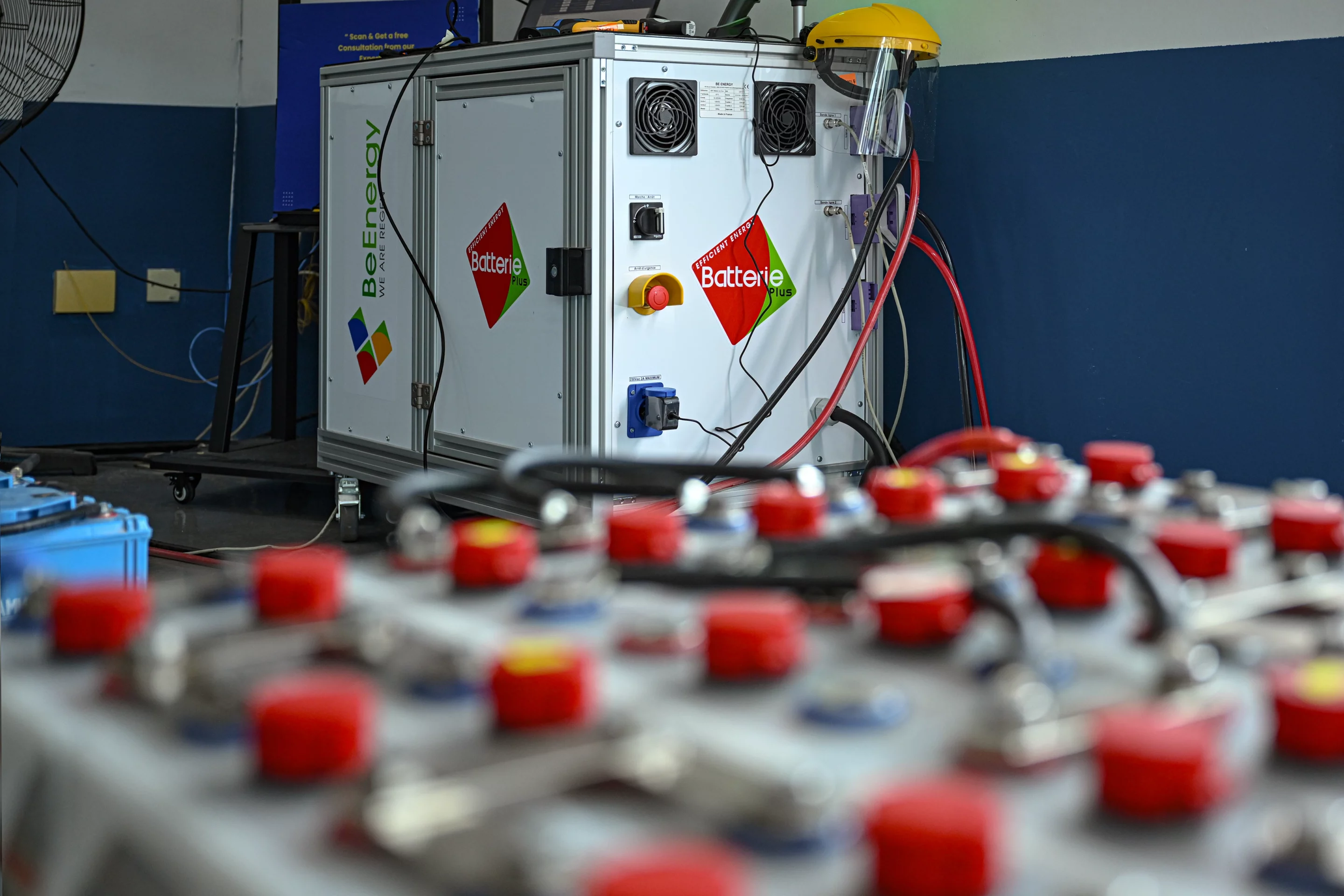
1. Operating batteries in an excessively hot environment
Temperature is one of the main factors affecting the ageing of stationary lead-acid batteries.
Even when they are not being used, batteries are subject to electrochemical reactions that change according to their operating temperature.
Prolonged exposure to excessive heat accelerates positive grid corrosion, water loss and certain internal degradation mechanisms.
The consequences can be significant.
According to EUROBAT recommendations, for valve-regulated lead-acid (VRLA) stationary batteries operating on float charge, a sustained temperature increase of 10°C can reduce their expected service life by approximately 50% compared with reference temperature conditions.
As a result, a battery designed to operate for several years may have its service life considerably shortened if its operating environment is not properly temperature-controlled.
Conversely, excessively low temperatures can temporarily reduce available capacity and, consequently, the installation’s backup time.
Reference values depend on the technology and manufacturer, but many stationary lead-acid batteries are designed to operate under optimal conditions at around 20 to 25°C.
During our on-site interventions, we regularly find that the actual temperature experienced by the batteries does not always match the temperature displayed by the room’s air-conditioning system. This difference can have a significant impact on their ageing.
Good practice: regularly monitor both room and battery temperatures, minimise heat sources and comply with the operating conditions recommended by the manufacturer.
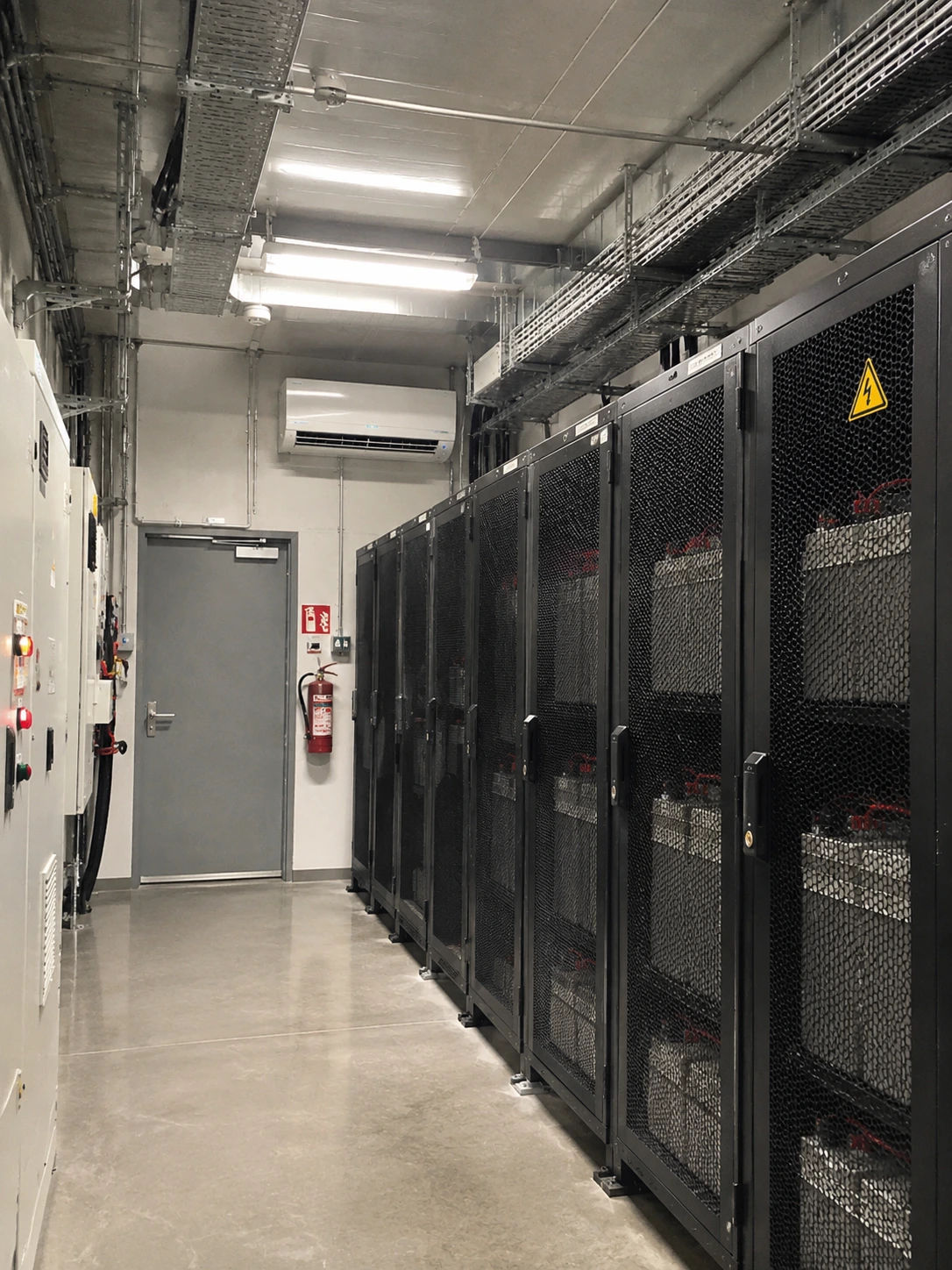
Excessive temperatures accelerate the ageing of stationary batteries and can significantly shorten their service life.
2. Incorrectly setting the float charging voltage
A stationary battery designed to provide backup power generally remains permanently connected to a charging system.
This maintenance charging method, known as float charging, compensates for self-discharge and keeps the battery ready whenever the installation needs it.
However, a battery that remains connected to a charger is not necessarily being charged correctly.
If the float voltage is too high, it can cause prolonged overcharging, promote internal corrosion and accelerate water loss. In some valve-regulated lead-acid batteries, it can also contribute to excessive heating and, under unfavourable conditions, thermal runaway.
If the float voltage is too low, conversely, the battery may be unable to recover or maintain a sufficient state of charge. In lead-acid batteries, this situation promotes plate sulfation and gradual capacity loss.
Temperature must also be taken into account. For many lead-acid batteries, the recommended charging voltages vary according to temperature.
The quality of the power supply also matters. Excessive current or voltage ripple from the rectifier can place additional stress on the batteries and contribute to premature ageing.
In an installation operating continuously for several years, these deviations can go unnoticed for a long time.
This is why, during our diagnostic assessments, we pay particular attention to the charging parameters. They can sometimes reveal the cause of deterioration that might otherwise be attributed solely to the age of the batteries.
Good practice: check float charging settings, ensure they are appropriate for the battery technology and operating temperature, and verify that the charging system is functioning correctly.

In data centres, stationary batteries used in uninterruptible power supply (UPS) systems are kept on float charge to ensure a continuous power supply to servers in the event of an outage.
3. Using a standby battery for regular cycling
Not all stationary batteries are designed to withstand the same operating conditions.
A battery intended to provide backup power in a UPS system does not necessarily have the same characteristics as one designed for energy storage and regular charge-discharge cycles.
In a backup power installation, the battery is generally maintained on float charge and only used occasionally, particularly during power outages.
By contrast, batteries used in certain photovoltaic or off-grid energy storage installations may undergo daily charging and discharging cycles.
This distinction is important.
Deep or repeated discharges can accelerate the ageing of a battery that was not designed for this type of use.
Depth of Discharge (DoD) refers to the proportion of a battery’s capacity that has been used during discharge.
The greater the depth of discharge, the more severe the electrochemical stress can be, depending on the battery’s technology and design.
A battery used under conditions different from those originally intended may therefore lose performance more quickly.
Our approach is to understand not only the battery technology, but also how it is actually used. This is essential for correctly interpreting its ageing condition.
Good practice: make sure the battery technology and model are suited to the installation’s actual operating requirements, particularly the frequency and depth of discharge cycles and the required backup time.
4. Leaving a battery discharged for too long
A stationary battery may remain discharged or insufficiently recharged following a power outage, a maintenance operation or a period in storage.
This situation is particularly problematic for lead-acid batteries.
During discharge, lead sulfate naturally forms on the plates. This is part of the battery’s normal operation and remains largely reversible when the battery is recharged correctly.
However, when a battery remains at an insufficient state of charge for too long, the lead sulfate crystals can develop and become increasingly difficult to reconvert.
This phenomenon is known as sulfation.
Over time, it can lead to a reduction in available capacity, increased internal resistance and deteriorating performance.
The problem also affects batteries stored before installation.
Even when disconnected from all equipment, batteries undergo natural self-discharge. Without appropriate monitoring and recharging, their state of charge can gradually fall to an excessively low level.
A new battery stored for an extended period under unsuitable conditions may therefore already show reduced performance before it is even put into service.
Sulfation is one of the degradation mechanisms we investigate when diagnosing lead-acid batteries. Depending on its severity and the battery’s overall condition, some capacity losses can be recovered through regeneration.
Good practice: ensure the battery returns to an appropriate state of charge after every discharge and implement a monitoring programme for stored batteries, following the manufacturer’s recommended recharging intervals and procedures.
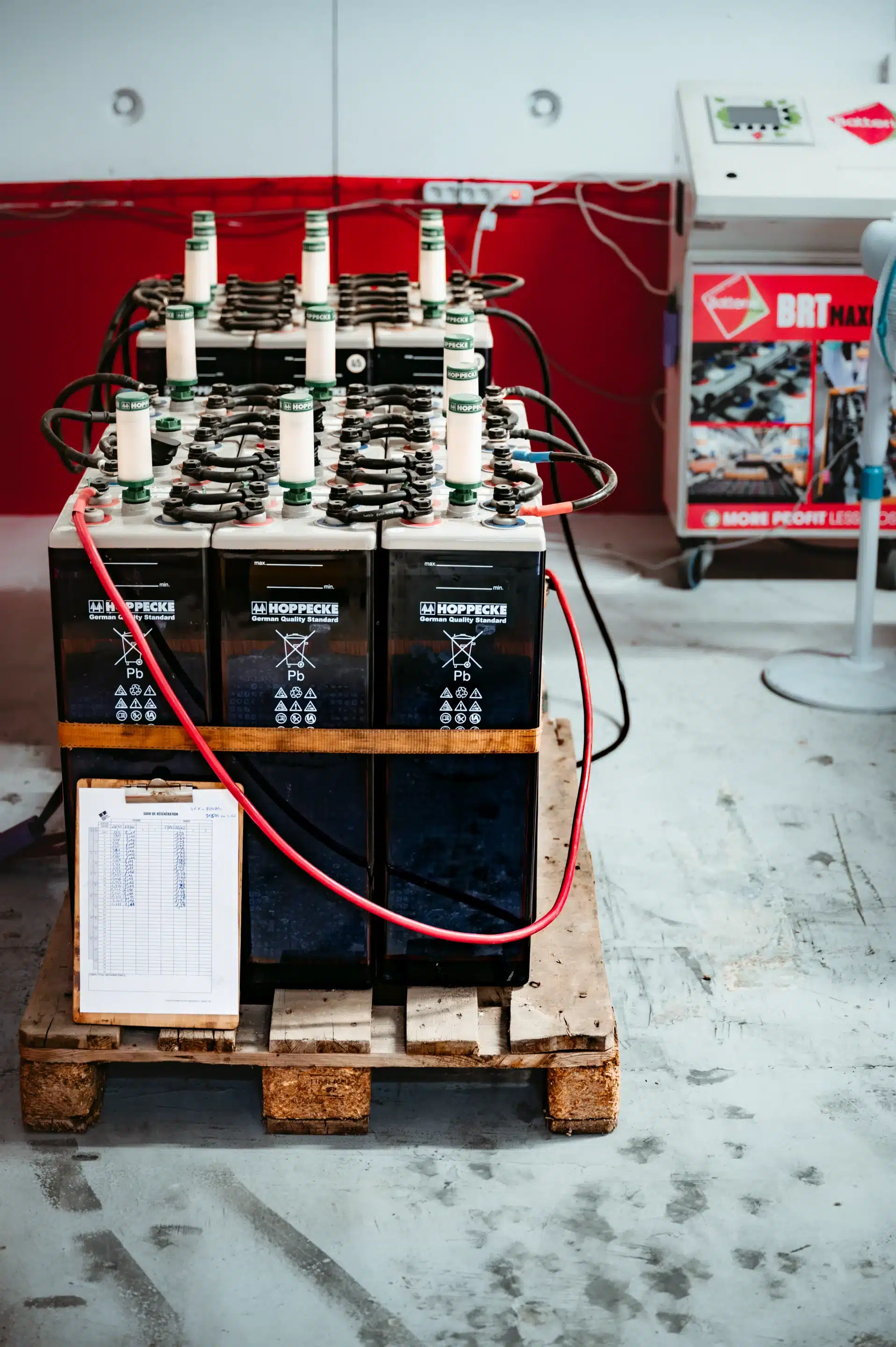
Is your battery already losing backup capacity?
A drop in performance does not necessarily mean that it needs to be replaced. Find out how to assess its condition and identify its regeneration potential.
5. Neglecting maintenance because the batteries are stationary
Because they are installed in a technical room and rarely handled, stationary batteries can give the impression that they require very little maintenance.
However, maintenance requirements vary considerably depending on the battery technology.
Flooded lead-acid batteries, including certain OPzS batteries, use a liquid electrolyte whose level must be monitored.
During operation and recharging, some of the water contained in the electrolyte may be consumed.
If the level becomes too low, the plates may become partially exposed and suffer significant damage.
Water topping-up must be carried out using water that meets the manufacturer’s specifications, generally demineralised or purified water, and in accordance with the recommended procedures.
AGM and GEL batteries operate differently.
These valve-regulated lead-acid batteries, also known as VRLA batteries, do not require water topping-up. However, this does not mean that they are maintenance-free in every respect.
They can experience gradual internal water loss, increased internal resistance or reduced capacity without these issues being immediately visible.
A battery that does not require water topping-up is not a battery that requires no monitoring.
Stationary NiCd batteries also have their own maintenance requirements, particularly flooded models using an alkaline electrolyte.
In the field, we sometimes encounter batteries whose deterioration could have been limited through more regular monitoring. The absence of visible problems can create a false sense of security, until the installation actually needs to rely on its batteries.
Good practice: adapt maintenance procedures to the installed battery technology and regularly check battery condition, even when the installation appears to be operating normally.

In photovoltaic installations, stationary batteries store solar energy for use when needed. Regular maintenance is essential to preserve their storage capacity and extend their service life.
6. Ignoring corroded or loose electrical connections
In a stationary battery installation, batteries are often connected in series or parallel to achieve the required voltage, capacity and power.
A battery bank may therefore consist of several dozen or even several hundred interconnected cells or battery blocks.
The quality of these connections plays an important role in the reliability of the system.
Over time, some connections may loosen, become corroded or develop contact faults.
A faulty connection can cause increased electrical resistance and localised heating when current flows through it.
This can disrupt the installation’s operation, cause voltage drops and, in the most severe cases, lead to electrical failure.
Connections are not the only components that need monitoring.
Dust, moisture, electrolyte residues and corrosion can also make battery inspection more difficult and contribute to electrical faults.
In installations operating for many years, these problems can accumulate gradually.
During our interventions, we do not limit our assessment to the batteries’ electrochemical condition. Their environment and electrical connections are also important factors in understanding how the installation operates as a whole.
Good practice: include inspections of cables, electrical connections and signs of corrosion in routine checks. Electrical inspections and work must be carried out by appropriately qualified personnel, in accordance with the manufacturer’s instructions and the site’s safety procedures.

At telecommunications sites, stationary batteries keep the network operating during power outages. Corroded or loose connections can compromise their performance and the reliability of the backup power supply.
7. Mixing new and ageing batteries within the same battery bank
When a battery or individual cell begins to show signs of weakness, replacing it on its own may seem like the simplest solution.
However, replacing an ageing battery with a new one without assessing the characteristics of the rest of the installation can create new imbalances.
Within the same battery string, the individual batteries must operate together.
Yet their characteristics change over time: available capacity, internal resistance, and charging and discharging behaviour.
Combining batteries with very different levels of ageing can disrupt their operation.
Some may become overcharged while others remain insufficiently charged. These imbalances can contribute to faster deterioration.
The same problem can occur when batteries of different technologies, capacities or manufacturers are combined without a prior assessment.
This does not mean that partial replacement is always impossible.
In some installations, replacing an individual battery or cell may be considered after checking its compatibility and the condition of the remaining batteries. The available options depend on the technology, electrical configuration and manufacturer’s recommendations.
This is precisely why a diagnostic assessment of the entire battery bank is valuable. Our objective is to identify the batteries that are genuinely defective, while also checking whether the remaining batteries can continue operating together under suitable conditions.
Good practice: before replacing an individual battery or cell, assess the entire battery bank to verify compatibility with the remaining units and identify any potential imbalances.
8. Relying solely on voltage to assess battery condition
This is one of the most misleading mistakes in stationary battery installations.
A battery can display a perfectly normal voltage while having lost a significant proportion of its capacity.
In a float charging system, the charger maintains the batteries at a specified voltage.
This measurement confirms certain electrical conditions, but it does not accurately indicate how much energy the battery can still deliver.
An ageing battery may therefore appear to operate correctly for several years.
Then, during a power outage, its actual backup time turns out to be significantly shorter than expected.
This becomes particularly critical in essential installations such as telecommunications networks, data centres, industrial equipment and safety systems.
We encounter this situation during our diagnostic assessments: batteries displaying normal voltages but showing significant capacity loss when subjected to a discharge test. The difference between the voltage reading and the actual available capacity can be considerable.
To assess the condition of a battery bank correctly, several measurements may be required:
- The overall voltage of the installation.
- The individual voltage of cells or battery blocks.
- The internal resistance or impedance of the batteries.
- The operating temperature.
- Changes in measured parameters over time.
- The actual available capacity, when suitable discharge tests can be performed.
Resistance and impedance measurements can help detect certain deviations, but they do not always replace a capacity test.
Good practice: do not limit battery diagnostics to voltage measurements. Implement performance monitoring and carry out capacity tests appropriate to the installation’s requirements.

In metro networks, stationary batteries provide backup power for certain essential systems. A normal voltage does not guarantee sufficient backup time: only an assessment of their actual capacity can determine whether they are still able to fulfil this function.
Is your stationary battery bank showing performance differences?
A correct voltage reading does not guarantee sufficient backup time. Before considering replacement, a diagnostic assessment can determine the actual condition of the batteries and evaluate their regeneration potential.
9. Neglecting ventilation and temperature differences within battery racks
A properly air-conditioned battery room does not necessarily guarantee a uniform temperature for all the batteries installed inside it.
Within the same rack, two identical batteries can be exposed to different temperatures simply because of their position.
Several situations can explain these differences:
- Batteries positioned at the top of a rack: because warm air tends to rise, batteries installed on the upper levels may be exposed to higher temperatures.
- Batteries positioned in the middle of a row: when surrounded by other batteries, they may have more difficulty dissipating heat than those located at the ends.
- Batteries installed inside confined cabinets: insufficient airflow can encourage the development of warmer areas.
- Batteries located near a heat source: certain electrical equipment or specific room conditions can create temperature differences.
These differences may seem small, but their impact becomes significant when they persist over several years.
Batteries exposed to higher temperatures than their neighbours may therefore age more quickly, even though they belong to the same installation and are subject to the same general charging parameters.
We have encountered this situation during our on-site interventions: within the same rack, some batteries showed more advanced deterioration than others, particularly depending on their position.

Air-conditioning alone is not enough to guarantee optimal operating conditions: within the same battery bank, some batteries may deteriorate much faster than others.
The risk of premature battery dry-out
One possible consequence of these temperature differences is battery dry-out.
In flooded lead-acid batteries, excessive exposure to heat can accelerate the consumption of water contained in the electrolyte.
When the electrolyte level becomes too low, the plates may become partially exposed and suffer significant damage.
For AGM and GEL batteries, the problem is different but equally concerning.
These batteries are designed to recombine a large proportion of the gases produced during operation. However, high temperatures, overcharging or prolonged operation under unsuitable conditions can promote water loss through their pressure-relief valves.
Eventually, the remaining electrolyte may become insufficient to support the battery’s electrochemical operation properly.
This dry-out can lead to increased internal resistance, reduced performance and capacity loss.
Unlike flooded lead-acid batteries, AGM and GEL batteries are not designed for water topping-up during routine maintenance.
Advanced dry-out can therefore cause irreversible damage, making battery recovery difficult or even impossible.
A battery located in the middle of a rack may consequently fail sooner than its neighbours, without the overall room temperature immediately revealing the problem.
Our interventions on stationary battery banks have allowed us to observe these differences in ageing first-hand. Batteries installed side by side, sometimes on the same date, can show very different levels of dry-out. This is why their position within the rack is an important part of our assessment.
Good practice: do not rely solely on the room’s ambient temperature. Measure battery temperatures at different positions within the rack, particularly at the top, in the middle of rows and at the ends. Ensure sufficient ventilation and comply with the spacing requirements specified by the manufacturer.
What checks should be carried out on a stationary battery bank?
A stationary battery bank can operate for several years without showing any apparent signs of malfunction.
However, the absence of failures does not guarantee that its performance has been maintained.
Preventive maintenance helps identify deviations before they compromise the installation’s backup time.
The frequency of these checks depends on several factors: battery technology, operating environment, site criticality, battery age and the manufacturer’s recommendations.
A monitoring programme may include:
- Visual inspection of battery blocks and individual cells.
- Checking for swelling, cracks, leaks or deformation.
- Checking the cleanliness of batteries and their surroundings.
- Inspecting cables and electrical connections.
- Checking electrolyte levels in flooded batteries.
- Measuring the installation’s overall voltage.
- Measuring individual battery voltages.
- Measuring internal resistance or impedance, where appropriate.
- Checking charging and float voltage parameters.
- Measuring battery temperatures at different locations.
- Checking ventilation conditions in racks and cabinets.
- Reviewing the history of power outages and discharge events.
- Monitoring changes in available capacity.
A capacity test may also be necessary to confirm that the batteries can still provide the required backup time. This test must be planned with the installation’s operational continuity requirements in mind.
The objective is not simply to determine the condition of the batteries at a particular moment.
Above all, tracking changes in results over time makes it possible to detect gradual deterioration and plan the necessary interventions.
Maintenance, regeneration or replacement: how do you decide?
The age of a stationary battery alone is not enough to determine its condition.
Two batteries installed at the same time, in the same room and on the same rack, can show very different performance levels after several years of operation.
Their position, temperature differences, charging conditions and initial condition can all influence how they age.
The real question is therefore not simply:
“How long has this battery been installed?”
But rather:
“How much capacity can it still deliver, and what is the condition of its internal components?”
A diagnostic assessment helps identify the causes of certain performance losses and determine which interventions may be appropriate.
Depending on the results, several options may be considered:
- Keep batteries in service when they still meet the site’s requirements.
- Correct unsuitable charging parameters or installation conditions.
- Carry out preventive or corrective maintenance.
- Regenerate batteries when their technology and condition allow it.
- Replace individual batteries or cells when technically appropriate.
- Replace batteries with damage that is too advanced or irreversible.
Regeneration may be particularly valuable when certain capacity losses are linked to degradation mechanisms that can be addressed through appropriate treatment.
In lead-acid batteries, it can recover some or all of the lost performance in certain cases of reversible sulfation.
Suitable processes also exist for certain stationary NiCd batteries.
However, regeneration cannot repair every type of damage. Advanced corrosion, structural damage or severe dry-out can make some batteries impossible to recover.
This is why a diagnostic assessment is essential before making any decision.
At Be Energy, this approach helps identify which batteries can remain in service, which have regeneration potential and which genuinely need to be replaced.
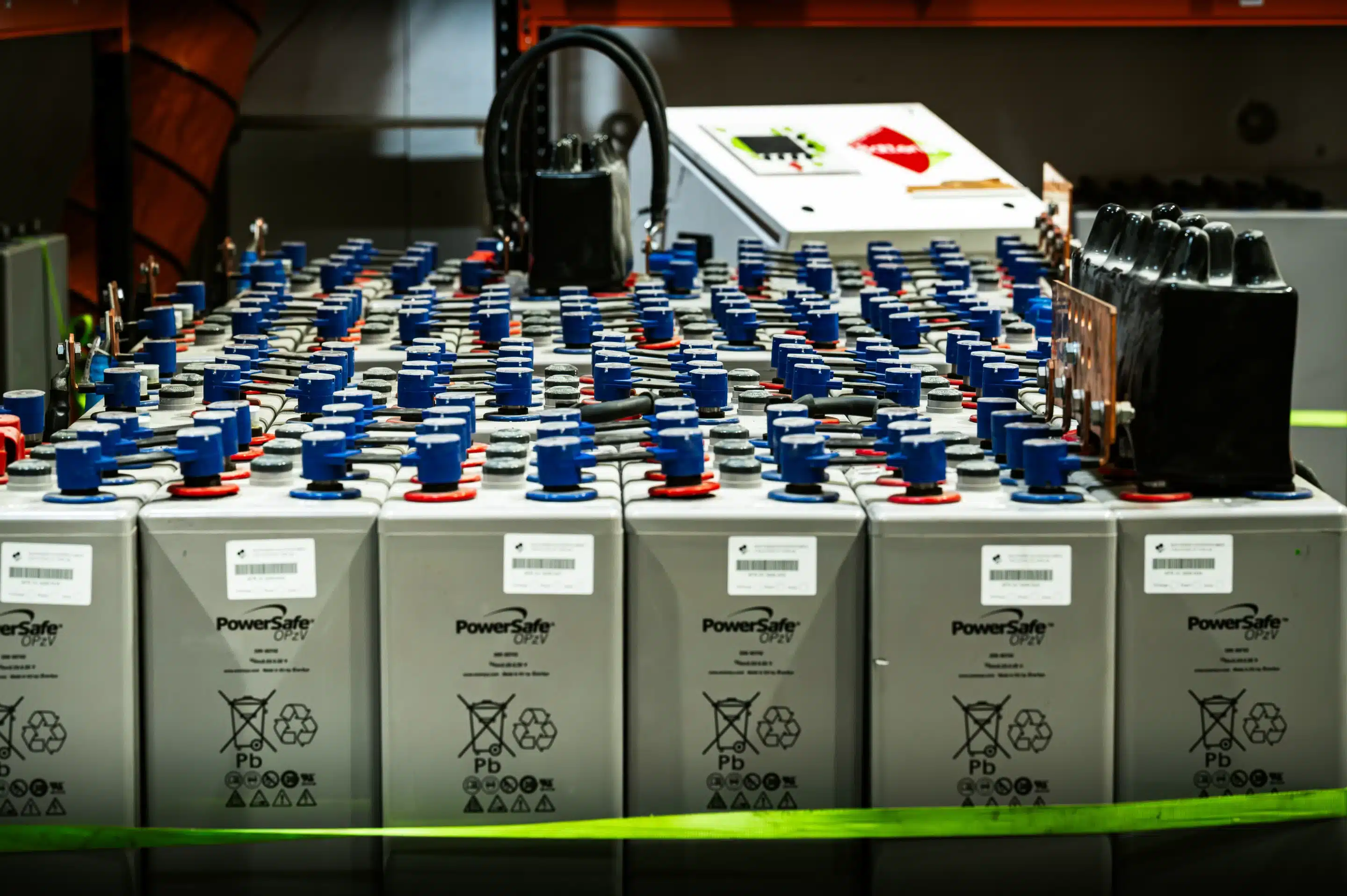
Anticipating battery ageing rather than waiting for failure
Stationary batteries often perform an essential function in installations where maintaining a continuous power supply is critical.
However, their apparent availability should not obscure the fact that they are still subject to ageing.
Excessive temperatures, incorrect float charging settings, insufficient ventilation or inadequate monitoring can accelerate their deterioration, even when they are rarely used.
Conversely, appropriate maintenance and regular performance monitoring help operators better understand how their battery bank is ageing and anticipate necessary interventions.
When a battery begins to lose capacity, replacement should not be considered without first assessing its actual condition.
A diagnostic assessment can determine whether maintenance or regeneration could extend its service life while meeting the installation’s reliability requirements.
This approach helps avoid premature replacements, improve cost control and reduce resource consumption.
Are your stationary batteries showing signs of ageing?
Be Energy supports businesses with the diagnosis, maintenance and regeneration of their stationary lead-acid and nickel-cadmium batteries.
Whether your installation contains just a few battery blocks or several hundred cells, our teams can help you assess the performance of your battery bank and identify the most appropriate interventions.
Before investing in new batteries, find out whether your existing ones can recover some of their performance.