


Be Energy : Batteries Plus Solutions
LEAD-ACID AND NICD BATTERIES
Stationary Batteries
Stationary batteries play an essential role in maintaining a continuous power supply. From telecommunications and industrial facilities to data centres, transport networks and energy storage, they provide a reserve of energy whenever the installation needs it.
Lead-acid technology is widely used in stationary applications, particularly for uninterruptible power supplies (UPS) and backup power systems. Nickel-cadmium (NiCd) batteries also serve certain industrial facilities and demanding infrastructure applications.
Understanding how these batteries work, their characteristics and their ageing mechanisms helps operators select suitable batteries, maintain performance and extend service life.
A stationary battery is an electrochemical energy storage device designed for a fixed installation. Unlike a traction battery, which powers mobile equipment, it provides backup power or energy storage at a fixed site.
Depending on its design and application, it is intended to:
- take over if the main power supply fails,
- keep equipment running for the required backup duration,
- store energy for later use.
A standby battery is generally kept on float charge, while a battery used for energy storage may undergo regular charge and discharge cycles.
How does a stationary battery work?
A stationary battery stores and releases energy through reversible electrochemical reactions. During discharge, it supplies current to the connected equipment. During charging, an external electrical source replenishes its stored energy.
In a lead-acid battery, these reactions involve lead and lead dioxide plates, together with an electrolyte containing sulphuric acid.
In a NiCd battery, they involve nickel- and cadmium-based active materials in an alkaline electrolyte.
In standby applications, a charger keeps the battery ready for use by applying a maintenance voltage, known as the float voltage. If the main power supply is interrupted, the battery provides the energy required by the system.
Charging parameters must match the battery technology and model. Correct settings help preserve both capacity and service life.

What is a stationary battery made of?

A stationary battery consists of electrochemical cells connected to provide the electrical characteristics required by the installation.
Each cell contains positive and negative electrodes, separators, an electrolyte and a container. Cells or battery blocks are interconnected and can be installed on suitable stands or racks.
For lead-acid batteries, the nominal voltage is approximately 2 V per cell. A 12 V monobloc therefore contains six cells connected in series. The electrolyte may be:
- liquid in flooded batteries,
- absorbed in glass fibre separators in AGM batteries,
- immobilised as a gel in GEL batteries.
For NiCd batteries, the nominal voltage is approximately 1.2 V per cell. The electrolyte is an alkaline solution, usually based on potassium hydroxide.
These differences affect the number of cells required, charger settings and maintenance procedures.
Different stationary battery technologies
Lead-acid is an established technology for many stationary applications. Three main variants meet different operating requirements.
Flooded lead-acid batteries, including tubular-plate OPzS batteries, use a liquid electrolyte. They require electrolyte level checks and water topping-up in accordance with the manufacturer’s recommendations.
AGM batteries belong to the valve-regulated lead-acid, or VRLA, family. Their electrolyte is absorbed in glass fibre separators. They do not require water topping-up and are frequently used in UPS and backup power systems.
GEL batteries, also part of the VRLA family, use a gelled electrolyte. Certain ranges, including tubular-plate OPzV batteries, combine a long float life with cycling capability.
The choice depends on power demand, the required backup duration, operating conditions and maintenance arrangements. Batteries that do not require water topping-up still need regular checks.
Alongside these lead-acid technologies, some installations use nickel-cadmium batteries.
Nickel-cadmium (NiCd) stationary batteries
NiCd batteries are used in certain industrial applications and demanding infrastructure environments. Their robustness and performance under challenging temperature conditions make them suitable for backup power and continuity of service.
Their use varies by sector, country and the history of the installation. They remain present in certain industrial battery fleets and infrastructure installations in Africa, although this should not be generalised across the continent.
The presence of cadmium, a toxic metal, requires careful management of these batteries throughout their use and at the end of their life. Applicable restrictions depend on the country, application and battery category. Rules governing portable batteries should not automatically be applied to industrial stationary batteries.
For existing battery fleets, the priority is to check the actual available capacity, maintain the required level of reliability and determine which batteries can remain in service.
Stationary battery applications
Stationary batteries meet the needs of many installations, with technologies and product ranges suited to each application:
- Telecommunications: backup power for base stations and communications equipment.
- IT and data centres: energy reserves for UPS systems.
- Industry and power networks: power for control, protection and monitoring systems.
- Transport and infrastructure: backup power for signalling equipment and technical installations.
- Building safety and services: power for essential equipment and emergency systems.
- Energy storage and off-grid sites: energy supply according to the installation’s needs, using batteries designed for cycling.
In every case, the battery must deliver the required power throughout the specified backup or discharge period.
Service life and ageing factors

The service life of a stationary battery depends on its technology, design and operating conditions. In standby applications, it is mainly assessed in years of service. In cyclic applications, discharge frequency and depth of discharge are also key factors.
Certain industrial ranges are designed to deliver 20 years of service or more. However, these figures relate to conditions specified by the manufacturer and do not apply to every battery.
In practice, actual service life can be significantly shorter. In cases encountered by Be Energy, it may reach 70 to 80% of the stated lifespan, and sometimes only half, depending on how the batteries are installed, stored, maintained and operated.
For a stated lifespan of 10 years, this could mean 7 to 8 years of use, or 5 years under less favourable conditions. These examples illustrate possible differences rather than a general rule.
The main factors affecting ageing include:
- operating temperature,
- appropriate charging settings,
- discharge frequency and depth of discharge,
- installation and storage conditions,
- the condition of electrical connections,
- regular inspections and maintenance.
A standby battery can lose capacity even if it is rarely used. A correct voltage reading alone does not guarantee the required backup duration: appropriate capacity tests help confirm that the battery still meets the installation’s needs.
Installation, storage or operating errors can accelerate this deterioration. Identifying them early helps preserve both battery performance and regeneration potential.
Stationary battery regeneration: extending service life
Lead-acid and nickel-cadmium stationary batteries offer significant potential for regeneration using Be Energy technology. A loss of capacity does not automatically mean they need to be replaced.
Following a diagnostic assessment, a treatment tailored to each technology can recover capacity in suitable batteries, extend their use and reduce premature replacements. Performance is checked before batteries are returned to service.
However, regeneration has its limits: it cannot repair irreversible damage. A poorly installed or maintained battery or battery bank can become unrecoverable, even in an air-conditioned room. Installation, charging and maintenance conditions remain essential to preserving the battery fleet and its recovery potential.
Be Energy helps you identify which batteries can remain in use and which need to be replaced.
How to choose the right stationary battery
Choosing a stationary battery starts with an assessment of the required duty. Providing a few minutes of high-power backup is very different from supplying energy over several hours.
Several criteria should be considered:
- the system voltage and its operating range,
- the required power and backup duration,
- the available capacity at the intended discharge rate,
- standby use or regular cycling,
- the technology best suited to site conditions,
- charger compatibility and settings,
- temperature, ventilation and available space,
- maintenance and monitoring requirements,
- the total cost over the battery’s service life.
Ampere-hour capacity alone is not enough to compare two batteries. Sizing must be based on the manufacturer’s data and account for expected ageing.
Switching from one technology to another also requires a compatibility assessment, particularly when moving between lead-acid and NiCd batteries.
Technical guidance helps ensure that the chosen solution meets site constraints and the required level of availability.
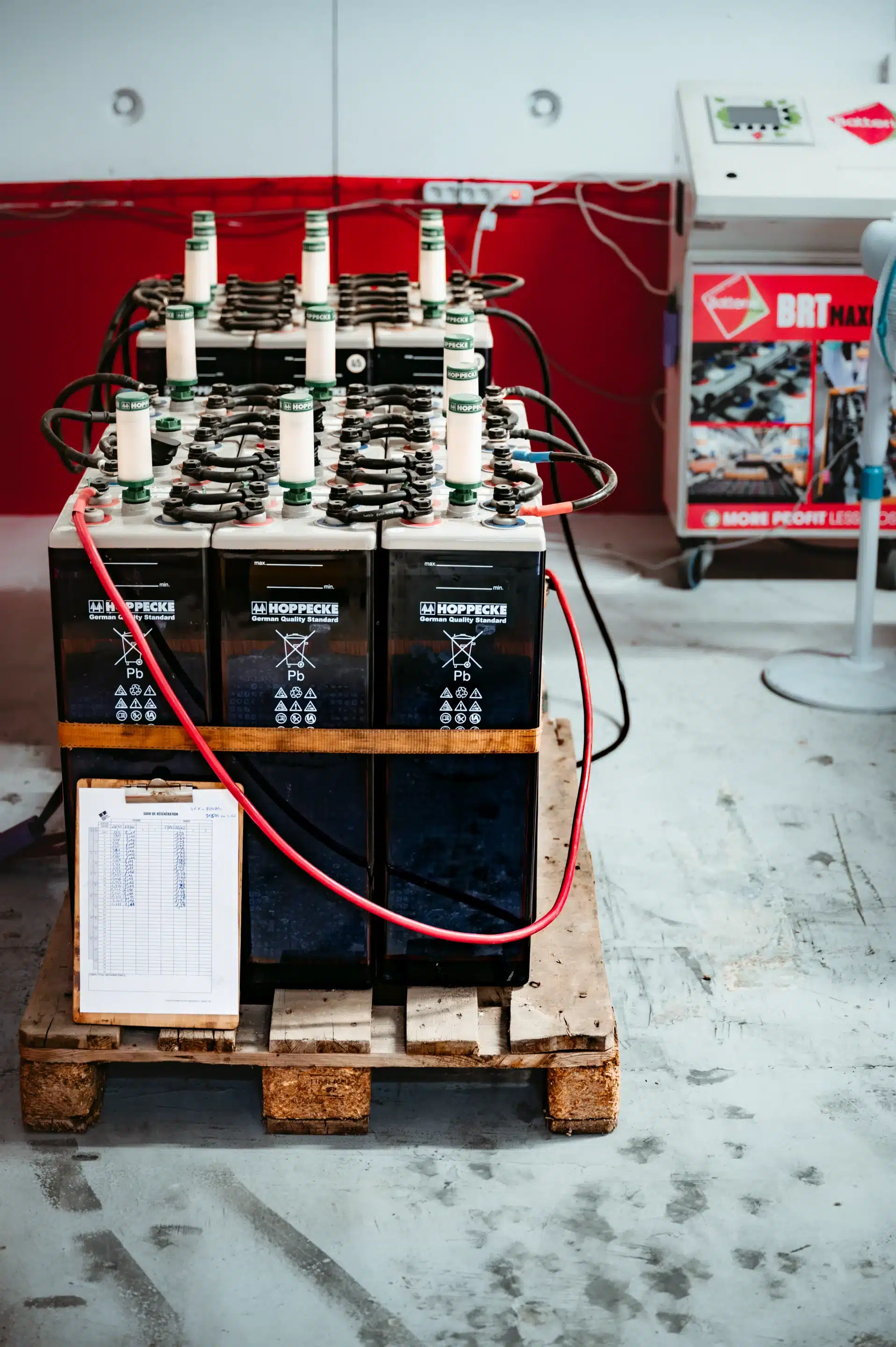
Be Energy, a specialist in stationary battery regeneration
Diagnostics, technical advice and regeneration: Be Energy supports professionals in managing their lead-acid and nickel-cadmium (NiCd) stationary batteries.
Our approach takes into account the characteristics of the battery fleet, the actual condition of the batteries and continuity-of-service requirements. It helps extend the use of batteries that still meet performance requirements and improve replacement planning.
Would you like to assess the condition of your stationary batteries and explore their regeneration potential? Contact us for an assessment tailored to your needs.