


Be Energy : Solutions Batteries Plus
LEAD-ACID BATTERIES
Lead-acid battery regeneration process: the 7 steps
Lead-acid battery regeneration is a controlled electrochemical process that restores batteries that have become unusable due to sulfation. The lead-acid battery regeneration process acts directly on the cause of capacity loss: the crystallization of lead sulfate on the internal plates.
This treatment is carried out in a workshop, according to a specific protocol, using specialized equipment.
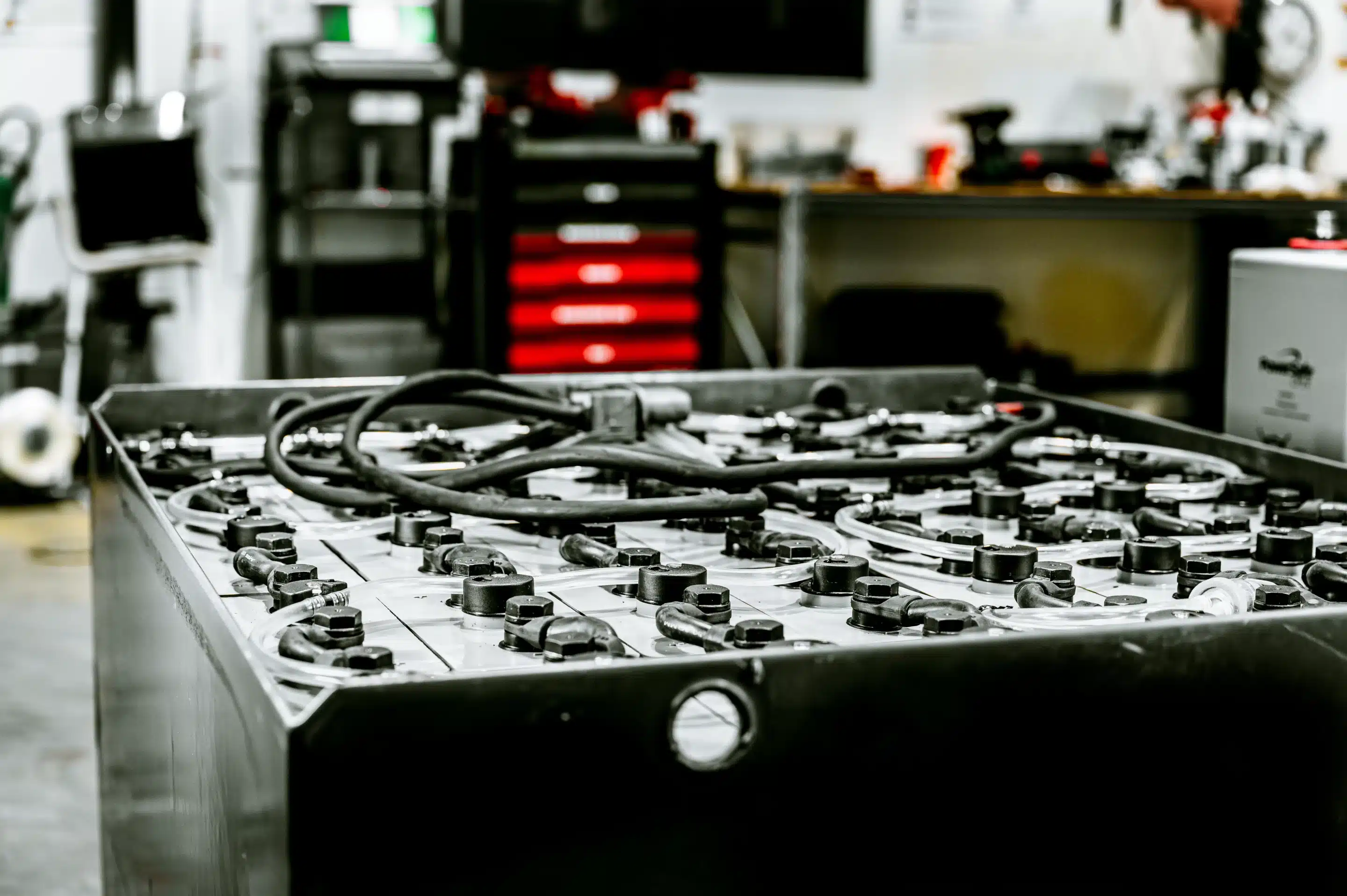
Why does a lead-acid battery become sulfated?
When a battery discharges, the positive and negative plates turn into lead sulfate. If the battery is not recharged quickly, this sulfate crystallizes.
This crystallization prevents recharging with a traditional charger. The battery then appears to be out of service, even though its internal components are still functional.
The lead battery regeneration process breaks down this crystallization.
Regeneration is based on sending high-power, precisely controlled electrical pulses.
These pulses will:
-
break up the lead sulfate crystals,
-
return the sulfate to solution in the electrolyte,
-
restore acidity,
-
chemically reactivate the plates.
A conventional charger cannot perform this operation.
The 7 steps of lead battery regeneration
1. Complete Battery Cleaning
The battery undergoes a complete cleaning process to remove acid deposits, conductive dust, surface oxidation, and operating residues.
This step also allows for a precise visual inspection of the condition of the cases, terminals, and sealing areas, while ensuring a neutral environment for the upcoming measurements.
The objective: eliminate any source of measurement interference and any risk of parasitic electrical leakage, in order to secure the inspection process and establish a reliable baseline for diagnosis.
2. Disconnection and Replacement of Connectors
Bridges, terminal lugs, cables, and connecting elements are removed to allow the process to continue and to provide access to the battery’s various components.
Connectors showing signs of corrosion are replaced in order to restore the battery’s connection points to proper working condition.
The objective: prevent leakage currents and short-circuit risks caused by degraded connectors, and ensure proper operating conditions for the remainder of the treatment.
3. Initial Voltage and Density Measurements
Each cell is individually measured to establish the battery’s initial condition:
- voltage per cell
- electrolyte density
- consistency between cells
- identification of significant deviations
These measurements form the reference baseline prior to treatment.
The objective: establish an objective comparison baseline to accurately assess the impact of the regeneration process.
4. Initial Discharge and Start of Regeneration
The battery is first subjected to a controlled, instrumented discharge in order to characterize its behavior under load and record its initial electrical curves.
It is then connected to the regenerator, which applies high-energy electrical pulse sequences, with controlled frequency and amplitude, for 24 to 96 hours.
These pulses enable:
- fragmentation of sulfate crystals
- their dissolution back into the electrolyte
- progressive restoration of acidity
- reactivation of the plates’ active surfaces
The objective: act on the crystalline structure of lead sulfate, which is inaccessible through conventional charging.
5. Validation of Voltage and Density Measurements
The same measurements taken during the initial stage are repeated to assess the battery’s progress:
- voltage per cell
- electrolyte density
- overall consistency
This comparison verifies the electrochemical restoration and the balancing of the cells.
The objective: validate the intermediate effectiveness of the treatment and confirm the progress of the regeneration process.
6. Final Qualification Discharge and Report Issuance
A final controlled discharge is carried out to qualify the battery’s actual performance after treatment.
The data collected allows analysis of:
- voltage stability under load
- restored usable capacity
- cell stability
- overall consistency of electrical behavior
A qualification report is then issued based on these results, including the recorded discharge curves.
The objective: objectively validate the final performance and document the quality of the regeneration process.
7. Battery Recharging and Water Circuit Installation
The battery is recharged according to its optimized profile. Electrolyte levels are adjusted as needed, and a new water circuit is installed for the final watering.
The objective: ensure the battery is returned to service in optimal performance and durability conditions prior to shipment to the customer.
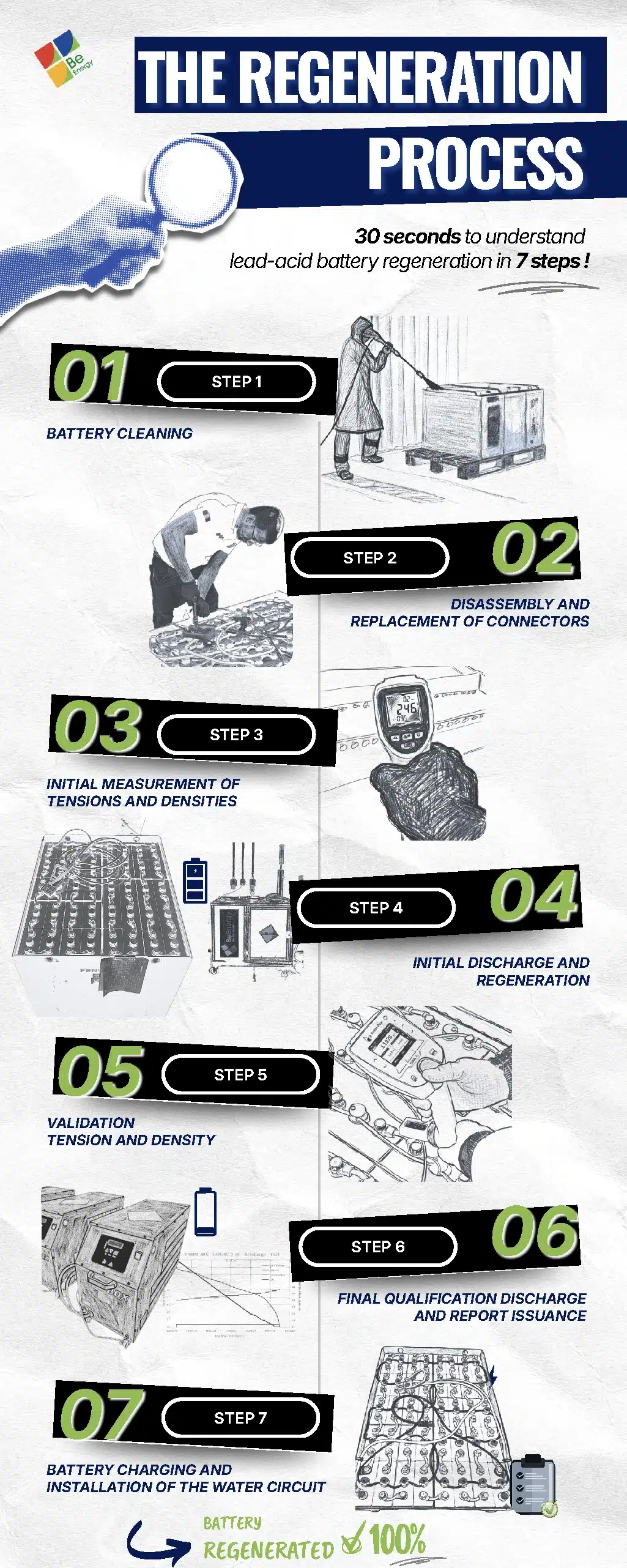
These seven steps constitute an inseparable sequence of operations.
Each step prepares for the next and contributes to the measurable electrochemical restoration of the battery.
The process of regenerating a lead-acid battery is not based on simple charging, but on an instrumented methodology, comparative readings, and the application of appropriate electrical pulses.
It is this rigorous execution that makes it possible to obtain reproducible results in the workshop.
Regeneration then becomes a controlled technical process, based on measurements, curves, and objective parameters.
Extend your battery life and cut your costs
Before replacing your batteries, it is essential to know whether they can still be regenerated. Our diagnosis is based on our technical expertise and industrial protocol, guaranteeing a reliable and accurate assessment.
Thanks to this check, you can avoid unnecessary purchases, extend the life of your batteries, and reduce your costs, while also helping the environment.
Don’t let your batteries lose their potential: have them diagnosed today!
Ready to audit the potential of your deposit?
Contact our experts for a personalized analysis of your fleet. Together, let’s move from waste management to sustainable asset management.