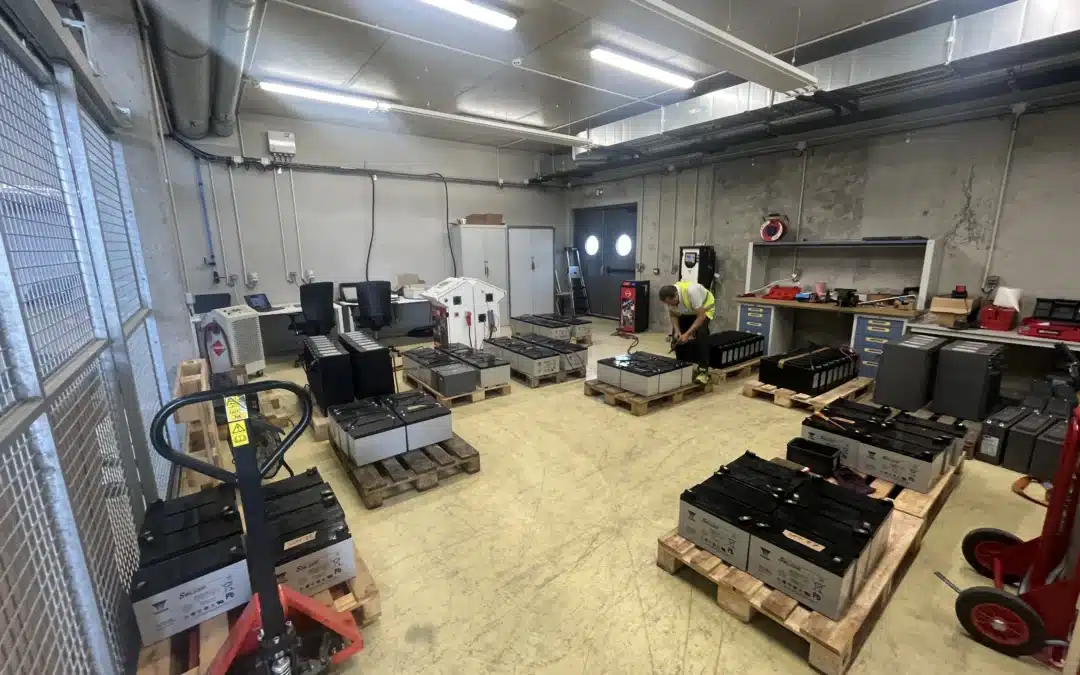
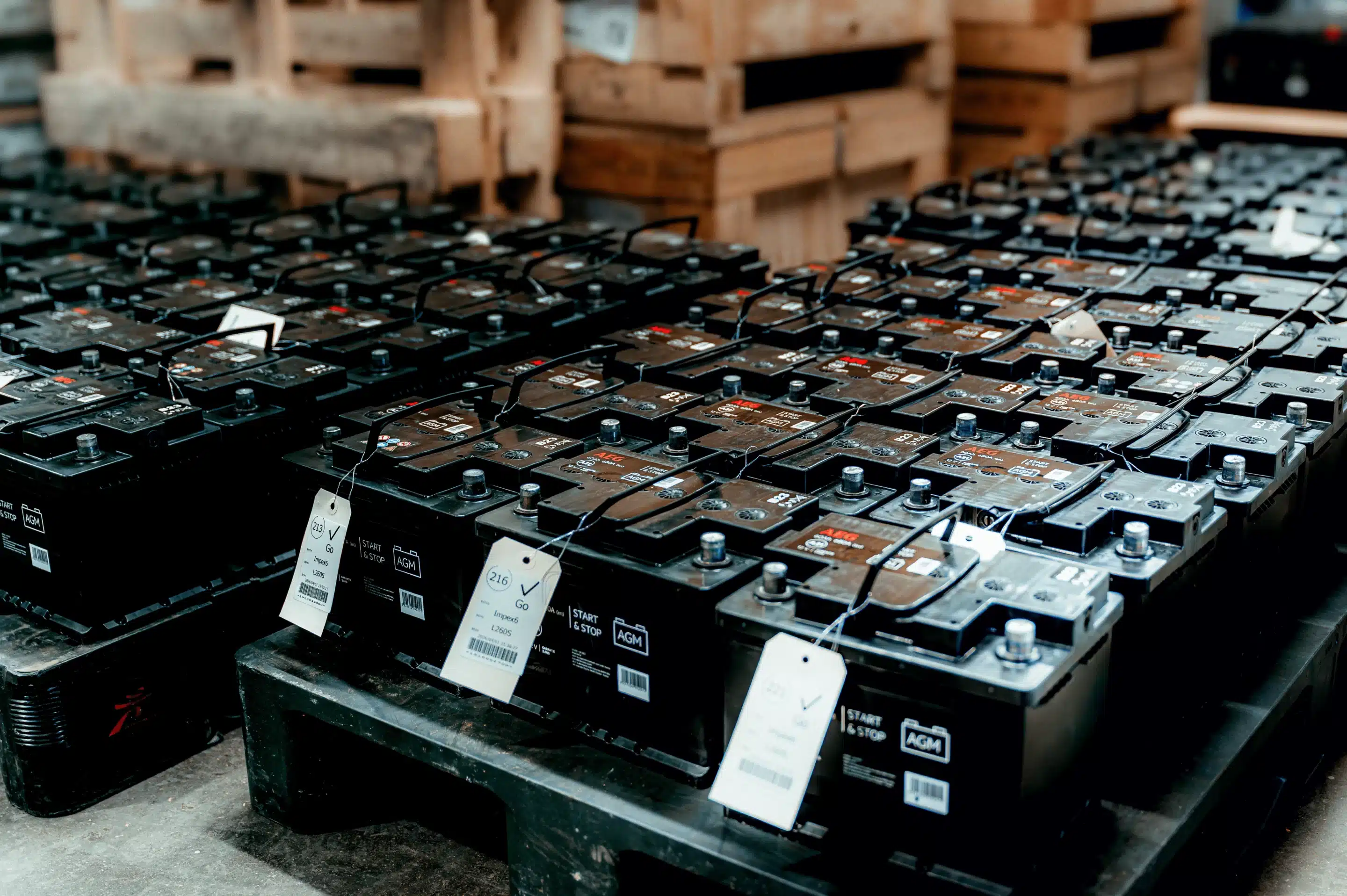
These starter batteries have been regenerated to restore their performance after an extended storage period.
A new battery can lose performance after several months of storage, even without being used.
In the collective imagination, a new battery is necessarily synonymous with reliability, full capacity, and immediate performance.
However, in practice, the reality is sometimes quite different.
In recent weeks, we were approached about a particularly interesting issue by a major French network specializing in the distribution of automotive parts and batteries. Their problem was simple, but far from trivial: some of their starting batteries, although new and never installed in vehicles, were no longer delivering 100% of their performance after several months in storage.
At first glance, this may seem surprising. And yet, this phenomenon is far more common than one might think in the automotive sector.
A battery can age… even without being used
Contrary to common belief, a battery does not remain static over time when stored on a shelf.
Even when new, a lead starting battery naturally continues to evolve. Over weeks and then months, it slowly discharges. If it remains unused for too long without proper maintenance or trickle charging, certain chemical imbalances begin to appear.
This is particularly the case with sulphation, a well-known phenomenon in lead-acid batteries. Gradually, sulfate crystals form on the internal plates, reducing the battery’s charge capacity and overall performance.
In some cases, the battery remains fully recoverable.
In others, performance drops to a level where the product is considered non-compliant for sale or use.
And this is precisely where the challenges begin for distributors.

The QTK enables stored batteries to be tested and requalified, helping to reduce losses, extend their service life, and avoid premature replacements.
A key issue for distribution networks

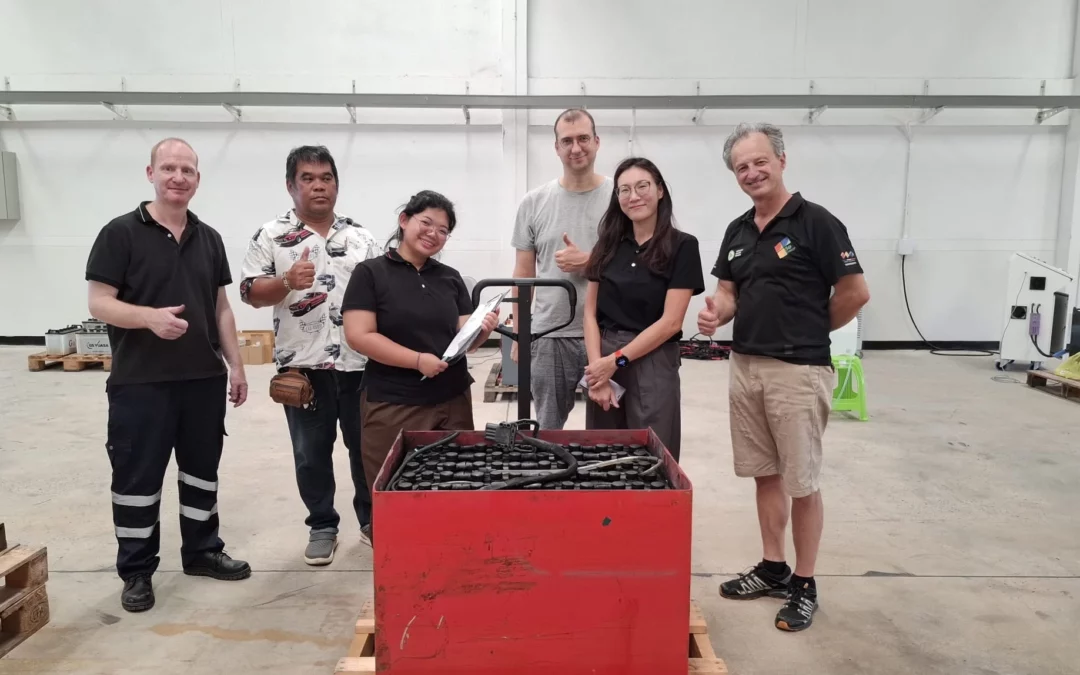
Regeneration allows the performance of starting batteries to be restored before any replacement decision is made.
In practice, industry professionals have to manage large volumes of batteries distributed across multiple logistics platforms, stores, or storage facilities.
Some references move quickly through inventory.
Others, however, can remain on shelves for several months before being sold.
Adding to this are:
- temperature variations,
- periods of low activity,
- logistical constraints,
- and safety stock requirements,
which together create a context where some batteries gradually lose efficiency without ever being installed in a vehicle.
The usual consequence is the same: these batteries are set aside, returned, replaced, or sent for recycling.
However, in many cases, they are still far from being truly at the end of their life.
Requalifying rather than replacing: changing the way we view stocked batteries
The issue does not always come from the battery itself, but from its condition after a long storage period.
A starting battery can lose performance without being truly unusable: it generally still retains an exploitable electrochemical base, simply degraded over time and by storage conditions.
In other words, it is not necessarily a product to discard, but rather a system whose condition can still evolve in the right direction.
It is within this logic that several hundred batteries were analysed, tested, and then integrated into a complete regeneration process.
All treated batteries were successfully regenerated, achieving a 100% positive outcome rate. This performance clearly demonstrates that regeneration is a fully operational solution for handling battery batches affected by prolonged storage.
Observations made on this type of stock therefore show that a performance drop due to storage does not systematically justify replacement.
On the contrary, regeneration emerges here as a particularly suitable alternative, making it possible to restore battery capacity, avoid premature disposal, and reintegrate them into a normal usage cycle.
For industry players, this opens a real alternative to losses linked to stock ageing and confirms the growing role of regeneration as a value-creation lever.

For distribution players, prioritising the regeneration of starting batteries helps extend their lifespan, reduce premature disposal, and actively contribute to a strategy of waste reduction and resource preservation.
An approach that is gradually reshaping industry practices
For a long time, the dominant reflex in the industry was relatively simple: a weakened battery had to be replaced.
But the landscape has changed.
Today, professionals must deal with:
- rising raw material costs,
- pressure on certain supply chains,
- environmental challenges,
- logistics costs,
- as well as increasing pressure around the circular economy.
In this context, extending battery lifespan is gradually becoming both an economic, technical, and environmental approach.
The question is no longer simply: “Should we replace it?”
But rather: “Can we still intelligently recover what already exists?”
And in many cases, the answer is yes.

A regenerated battery can return to normal use and re-enter the distribution network.
Regenerating before replacing: a common-sense approach
This operation perfectly illustrates a structural shift currently observed in the battery sector.
More and more players are adopting a new approach: testing, analysing, and regenerating before considering systematic replacement.
The benefits are multiple.
From an economic perspective, it helps reduce stock losses and avoid the premature disposal of still valuable products.
From an environmental perspective, it also reduces:
- waste,
- demand for new raw materials,
- as well as the carbon footprint linked to the manufacturing and transport of new batteries.
Finally, from an operational standpoint, this approach opens up new perspectives in stock and returns management.
An ongoing transition in the battery industry
The topic of regeneration is no longer limited to isolated cases or specific industrial applications.
Today, it is gradually extending to a wide range of uses:
- automotive batteries,
- professional fleets,
- industrial applications,
- stationary energy storage,
- electric mobility,
- and logistics.
And if this operation carried out on starting batteries illustrates it so clearly, it is because it highlights a simple reality:
A battery that has lost performance is not necessarily a battery to replace.
In many cases, it can still be given a second life.
And this is likely one of the major shifts the battery market will experience in the years ahead.
To go further…
What differentiates a simple loss of charge from an actual battery degradation?
A loss of charge is reversible with proper recharging, whereas degradation involves internal changes to the active materials that permanently limit performance.
Why do two batteries stored under the same conditions not necessarily age in the same way?
Slight differences in manufacturing, initial state of charge, or storage history are enough to create different ageing behaviours over time.
At what point does a battery actually start to lose capacity, even when not in use?
From the moment it is manufactured, but the loss becomes truly significant when it is neither recharged nor monitored over several weeks or months.